
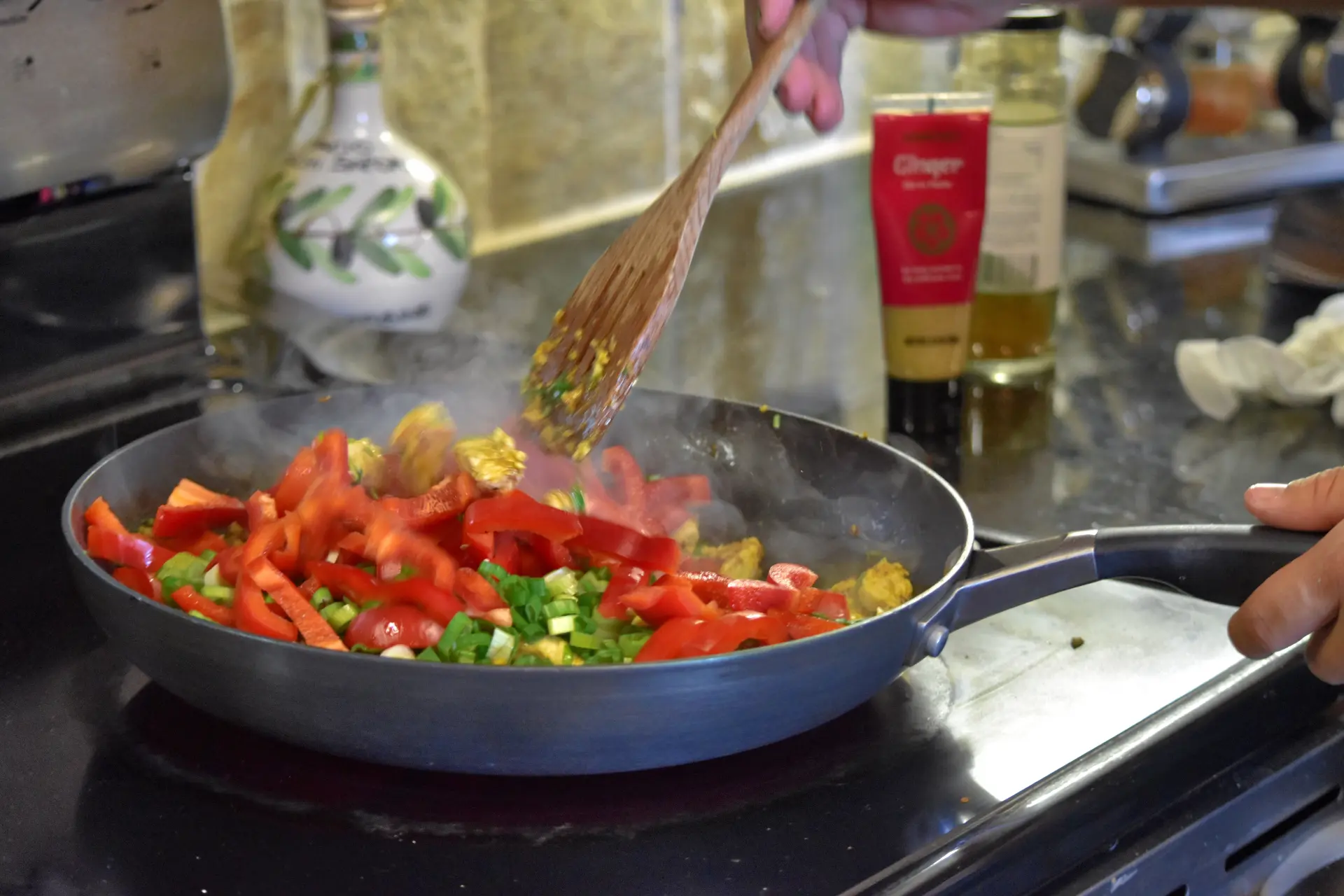
Fried foods are probably the first thing we’re told to stay away from after being diagnosed with a fatty liver disease (now called MASLD). Or maybe second, after sugar.
Either way, the standard advice is clear: the days of consuming deep-fried takeout are over. But does that mean you have to give up the satisfying sear of a sautéed meal or you can still “get away” with healthier options, like extra virgin olive oil (EVOO)?
If you want to fry food after being diagnosed with a fatty liver disease, extra virgin olive oil is a good choice. Recent studies show that EVOO is far more resilient than we once thought, and when used correctly, it won’t produce the unhealthy acrylamides that lower-quality oils do.
(Note: This is based on several studies, including the ones here or here.)
Of course, you shouldn’t use this knowledge as an excuse to eat grease. It just shows that we still have options after being diagnosed, that the right fats can actually support your liver recovery while keeping your meals tasty (and filling), and especially proving that EVOO is indeed the best choice of oil.
At the same time, the other option is completely doable too: I did it and I found it surprisingly good. You can read about my experience with fat free cooking here.
Frying or sauteing in olive oil if you have a fatty liver
In the past, it was considered that olive oil doesn’t have a high smoke point (aka, it burns quickly) but more recent ones – like the two I have linked above – found the opposite.
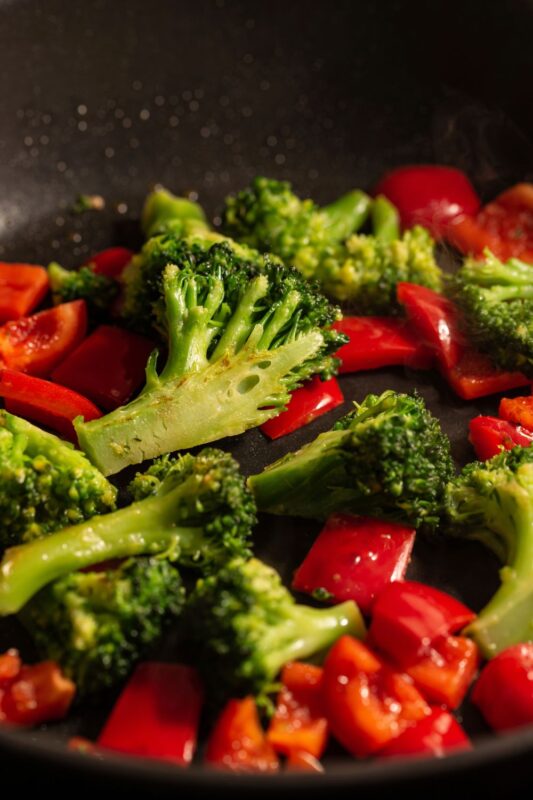
Not only that it does have a high smoke point, but extra virgin olive oil retains many of its antioxidants when fried, while keeping the amount of acrylamides (unhealthy chemicals produced when frying foods) to a minimum.
This is where we need to look at Oxidative Stability. While the “smoke point” tells you when an oil starts to visibly burn, oxidative stability tells you how well the oil resists breaking down into polar compounds that can stress your liver.
Because EVOO is packed with polyphenols, these antioxidants act as a built-in shield. They protect the fatty acids from heat damage, making it much safer for your liver than vegetable or seed oils that lack this natural protection.
The International Olive Council supports this, stating:
“In proper temperature conditions, without over-heating, it undergoes no substantial structural change and keeps its nutritional value better than other oils.”
Notice the “proper temperature” part. That is, according to them, 210 degrees Celsius (410 degrees Fahrenheit), while the “ideal” cooking temperature is 180 degrees (356 degrees Fahrenheit).
The USDA also agrees with these statements.
In other words, as long as the cooking temperature is right and you don’t heat the oil above these levels, things should be OK.
Curious about other foods too? You can read here whether or not should you eat eggs with a fatty liver or what type of dairy you should choose.
Sautéing vs. Air Frying
While the EVOO itself is safe, the method of “frying” matters immensely for liver health, as we’ve seen above.
This means that deep-frying (submerging food entirely in boiling oil) remains a habit to avoid. Even with EVOO, deep-frying creates a massive caloric load and can produce Advanced Glycation End-products (AGEs), which are compounds that trigger inflammation in a fatty liver.
Sautéing or stir-frying is the “Safe Zone.” By using a light coating of EVOO in a pan, you get the flavor and texture you want without soaking the food in fat.
For those looking for that specific “fried” crunch, the air fryer has become a game-changer. A quick spray of high-quality EVOO on your food before it goes into the air fryer gives you the benefits of the oil’s antioxidants with only a fraction of the calories. It is the most liver-friendly way to enjoy a “fried” texture, in my opinion.
If you want to read more on this matter, I have an article about Air Fryers and MASLD.
My take on frying in EVOO with fatty liver disease
I went to extremes to make sure I reversed my fatty liver after my diagnosis in 2014. At first, I barely used any added fat.
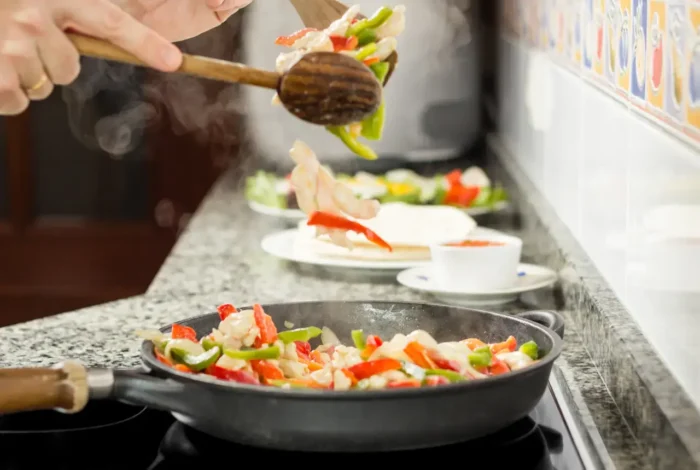
Eventually, I realized that wasn’t sustainable or even necessary, so I started adding EVOO back into my diet and even began sautéing foods again once I understood how to manage the heat.
If you REALLY think that you need to add extra oil to your foods when cooking, although that’s not really true in most cases, you can do the following:
Add one or two tbs of olive oil to the food AFTER you’ve cooked it, as soon as it’s done: this way, the temperature is no longer high enough to break it into unhealthy grease and you’ll get that oily taste too, including all the benefits.
NOTE: I said one-two tablespoons, referring to large quantities of prepared food (for a family, maybe even for a couple of days). If it’s just a portion, drizzle a bit of extra virgin olive oil, and not more (or use a spray). A single tablespoon has around 120 calories, so keep that in mind!
If you really want to sauté your foods or fry them a bit, you can indeed use extra virgin olive oil for the job. Make sure you use the best quality oil possible, though, to keep the nutrients high. And add as little as possible to your dishes.
Even though it doesn’t break into unhealthy chemicals, it still adds a ton of extra calories through fat – which you might not be aware of.
If you are and you keep your macros under control when cooking, then you can definitely use EVOO for cooking and frying your food.
Ever since being diagnosed in 2014, I can still count on my fingers the amount of times I ate French fries – and I can say the same about other types of deep fried meats. So it’s doable for sure.
And it’s definitely worth it!
After all, you don’t have to quit everything that’s taste. You can still have chocolate if you have a fatty liver disease, for example.
It’s Not Just the Oil
We sometimes focus so much on the oil and unrelated details that we forget about the food being fried. Sautéing a piece of wild-caught salmon or a pile of broccoli in EVOO is an excellent, liver-supporting meal.
The healthy fats in the oil actually help your body absorb the fat-soluble vitamins (A, D, E, and K) in your vegetables.
However, using EVOO to fry processed, breaded chicken nuggets or frozen appetizers doesn’t make those foods any healthier. The refined carbs in the breading and the preservatives in processed meats will still stress your liver.
To get the most out of using olive oil, ensure the “carrier” is a whole, nutrient-dense food.
Conclusion
While you should stay away from traditional deep-fried foods after a diagnosis of MASLD, extra virgin olive oil is an exceptional tool if you want to sauté or lightly fry your meals.
The science shows it is stable, heat-resistant, and packed with the antioxidants your liver needs to heal. Plus, let’s be honest: it makes foods tastier!
Just remember the golden rules: keep the heat moderate, don’t reuse the oil, and be mindful of the calories. Using a spray bottle can help you control the amount, or you can try my favorite method of adding the oil after the cooking process ends to keep the nutrients intact.
Have you made the switch to using extra virgin olive oil for cooking? Share your thoughts and experiences in the comments section below.
Or just continue reading about various foods – like the article about eating tofu if you have a fatty liver disease.


I was diagnosed with fatty liver in 2014 and successfully reversed it by mid-2015 using a natural diet and lifestyle changes. Since then, I’ve dedicated over a decade to researching this condition and helping others navigate their own recovery. I am the author of ‘From Fatty Liver to Healthy Liver’ and the founder of this community. My goal is to translate complex medical studies into practical, real-world advice that actually works, combined with my personal experience on the matter.
I’m not sure about others, but if I go off the beaten path and eat something I shouldn’t, I pay for it and have for many, many years. My body won’t even consume fried foods period. It gives me IBS issues.
Since I changed my diet, I don’t have that many problems. There are still things I’m supposed to be able to eat on the Fatty Liver diet, that I can’t eat on the LOW FODMAP diet for IBS, but it just gives me less options than most.
I eat a lot of salad now. I was never able to eat salad before. It turns out it wasn’t the veggies, it was the stupid store bought dressing that put me into IBS symptoms. I now make dressing with Cold Press Extra Virgin Olive oil, Balsamic Vinegar and raw Honey called Basswood that’s made in the Ohio, Illinois, Great lakes areas. It’s in the part of the country I’m from. It’s pretty amazing too. The olive oil I’m using is for dressings. These three ingredients are all I use. I guess I could squeeze some lemon juice in it but, made this way it doesn’t need to be refrigerated. I simply shake and pour when I’m ready to use it. I think I eat the salad for the dressing now. I also use a lot of leafy greens gotten at a local farmer. I live in the country, so whatever other fresh grown fruits and veggies I can I get I do.
I’ve stayed away from potatoes completely. This is super difficult for me. As is trying to find other things to do with Ground Turkey other than taco’s. That means frying the meat. I can do meatloaf but, I’m used to eating potatoes with them. It’s super difficult.
You see I just started this diet a couple of weeks ago. I was told years ago that I had a fatty liver. Nobody said, you need to change your diet. The doctor just said, it’s what’ll kill you. why don’t you get a bi-pass surgery? No. I don’t knock it if you do it, but I’ve worked with nurses in ICU and other other areas all of the USA. A lot of nurses say don’t do it. They have a lot of people that come through ICU’s from complications or infections. It’s not an easy process. To me though it’s changing my God given body. I just can’t feel right about that. It’s like saying, I don’t like your creation God, here let me fix that. I had another doctor say it the other day. Why do they push this? I will lose the weight. It’s not like I’m 300 lbs, yet. I’ve been within 15 lbs of my current weight for over 10 years. I’ll figure it out.
Thank you so much for all the information on this website. It’s been a great help in my new adventure. One that I should of been doing by now.
I am sorry to hear about your problems, Loretta – but I am also sure that you have what it takes to reverse this. It is indeed more complicated when additional problems are involved (like IBS), making the dieting part even more difficult, but there’s always a way out, as long as you can stick to your plans. And you will see that you’ll get adjusted to the new way of eating relatively fast.
Unfortunately, today I was told I needed an ultrasound guided liver biopsy. They believe it to be F4 cirrhosis. I’m not sure how. I don’t drink and haven’t in many years. I take that back I went 8 years and didn’t drink and for a short while 7 years ago I drink on Saturday for like 6 weekends. I drank once since then and that was 4 years ago. I don’t even have the desire. Especially now. I’m sticking to the liver friendly diet and do what I can to survive. If I can afford it.
I am sorry to hear that, Loretta. Dieting and sticking to an exercise plan is indeed what you need. There are people claiming that they have managed to reverse Cirrhosis as well by sticking to eating healthy, so don’t lose hope!
I can’t tell how much I needed to hear that. Thank you!
If olive oil is not good for frying then what is the best oil to to shallow fry ? I make healthy vegetable curry and slightly my onions and veg for 1 minute. Otherwise I don’t get good taste then will end up binge eating. I don’t like to use coconut oil as my go said reduce high fats.
Try using just a bit of water instead of the oil. If you really need to fry stuff, only use a tiny amount of oil.
If you do not use oil to fry, how do you sauté or cook meat? Do you use a non stick pan? I have dealt with high liver enzymes and a liver biopsy about 10 years ago, no problems with my liver. Every time I get a new doctor, the whole issue starts over due to high liver enzymes. I’m trying to find out what to do. I do not drink, but I’m constantly worried about this. I do not want to keep getting liver biopsies. Thank you, Tammy
Tammy, adding a bit of water to cook the meat in will work great. You can also use a non stick pan – see what works best for you.