
Note: This article is based on my personal experience and research. I am not a doctor or a dietitian, and this content is for informational purposes only. Always consult with your healthcare provider before making any changes to your diet or lifestyle.
When I was first told I had fatty liver disease, I decided to cut out fat almost completely. While this is a good idea for the most part, our bodies need some fat – and much of it can come from high-quality oil.
The truth is that not all fats are the enemy, like it happens with sugar, for example. In fact, the right kind of fat can actually help your liver heal AND also feed your body with nutrients it needs to thrive.
In today’s article, I will tell you exactly what type of oil to choose if you suffer from fatty liver disease – based on my own experience from reversing my condition, as well as solid research on the matter. Let’s begin!
Good Fats vs. Bad Fats
If you’ve been diagnosed with NAFLD (non-alcoholic fatty liver disease), you’ve probably heard the advice to reduce fats – it’s something I preach on this website also, and one of the things you must avoid to heal.
However, there’s a caveat: you should reduce bad fats, and keep consuming the “good” fats instead.
Deep-fried foods, fast food, margarine, processed snacks – these are loaded with trans and saturated fats that put more strain on your liver.
But monounsaturated and polyunsaturated fats, which support cell repair, reduce inflammation, and balance cholesterol, are recommended.
And these can easily be brought to your NAFLD-friendly diet by implementing healthy oils like extra virgin olive oil (my favorite and go-to oil type) or avocado oil. The key is quality and moderation.
The Best Oil for Fatty Liver: Extra Virgin Olive Oil
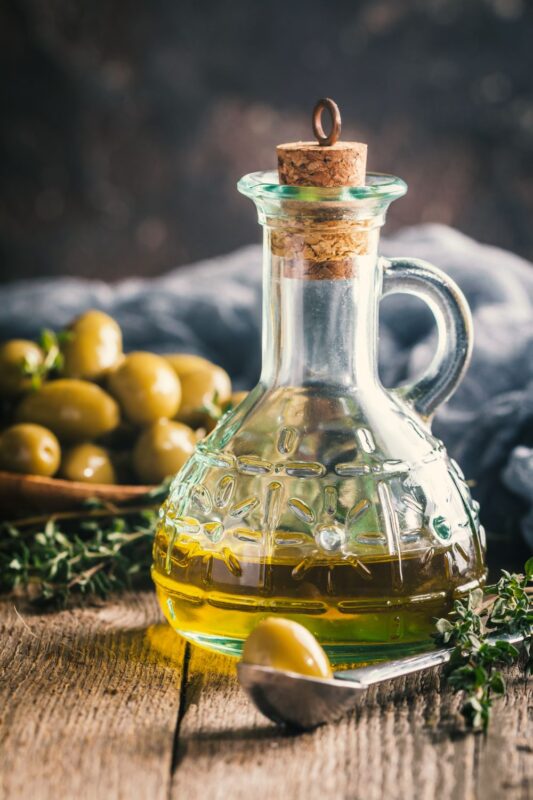
Among all oils, extra virgin olive oil (EVOO) is the one that consistently gets the thumbs-up from doctors, nutritionists, and researchers. It’s also the one that I personally used exclusively when I reversed my fatty liver (and the only type of oil I use even today).
Why EVOO? It’s rich in monounsaturated fats, which help reduce fat buildup in the liver.
It contains polyphenols and antioxidants like hydroxytyrosol, tyrosol, and squalene, which protect liver cells from damage (source here).
Studies show it may reduce liver fat, improve insulin sensitivity, and lower inflammation. It also supports heart health, which is important since fatty liver often goes hand-in-hand with cardiovascular risks.
To put it simply: EVOO is food for your liver. If you can go for organic brands, it’s even better.
I prefer Greek olive oil because it has a distinct, more powerful flavor and smell, but that doesn’t really matter much. Italian and Spanish brands are great choices too, just as is the case for any trustworthy brand you enjoy eating.
My Favorite Extra Virgin Olive Oils
Over the years, I’ve tried plenty of brands, but these are the ones I really enjoy today. (Please note: the links below are affiliate links).
1. Iliada Extra Virgin Olive Oil
This is by far the best tasting, most amazing EVOO that I have tried. I absolutely love it and I am sure that you will too, especially if you’re a fan of a stronger tasting oil.
It comes in a larger, 34-ounce (1-liter) can, so you should store it in a dark place so it doesn’t start oxidizing. Alternatively, you can split it into 2-3 smaller bottles (make sure they are really dark) and store them in a dark place.
2. Sky Organics Organic EVOO
Cold Pressed, unfiltered and Non-GMO award winning Organic Oil. This is a really high quality product which does come at a higher price than usual, but if you don’t mind spending a bit more for your health, it is a perfect choice.
It’s organic, unlike the brand recommended above and it has a solid flavor that last well. Comes from Greece too.
3. AmazonFresh Italian Extra Virgin Olive Oil
If you want to keep costs low, go for Amazon’s own brand and choose this oil made from Italian olives.
While it doesn’t have the same strong flavor that I love about most Greek olive oils, this could be an advantage for those who don’t really like that particular taste. It’s really cheap too, and that always comes as an added bonus.
How Much Olive Oil Should You Use?
One of the questions I get most often is: “How much olive oil should I eat daily?”
Most studies on the Mediterranean diet (the one that I recommend above, and the one I used to reverse my condition) suggest around 1–2 tablespoons per day as a healthy amount. That’s enough to drizzle over a salad, mix into a dressing, or add on top of cooked vegetables.
Remember, even healthy fats carry calories, so use your oil as a flavor enhancer, not as the base of your meals.
Why Not Other Oils?
This is where many readers start wondering: “But what about sunflower oil? Or coconut oil? Or the canola I already have at home?” Here’’s’s a quick comparison to save you from second-guessing:
| Oil Type | Safe for Fatty Liver? | Why / Why Not |
|---|---|---|
| Extra Virgin Olive Oil | ✅ Best choice | Rich in antioxidants and healthy fats |
| Avocado Oil | ✅ Good alternative | Similar benefits, but pricier |
| Sunflower/Corn Oil | ❌ Best avoided | Too high in omega-6, can promote inflammation |
| Canola (Rapeseed) Oil | ⚠️ Better than sunflower, but refined | Not as antioxidant-rich as EVOO |
| Coconut Oil | ⚠️ Use sparingly | High in saturated fat, not liver-friendly in large amounts |
| Peanut Oil | ❌ Not recommended | High omega-6, refined |
The short version? Stick to EVOO. Avocado oil works (study here) if you dislike olive oil’s flavor, but beyond that, other options don’t measure up for liver health.
How to use EVOO for maximum benefits for your liver
There are two things you should always remember:
1. Storage matters. Keep olive oil in a cool, dark place. If you buy a large can, transfer it to smaller dark bottles to slow down oxidation. If it smells rancid, toss it – oxidized oil is no longer healthy and can cause more harm.
This being said, I never had any oil go rancid, even when buying larger containers and not transferring the EVOO to smaller ones.
2. Cooking tips. EVOO has a relatively high smoke point (210°C / 410°F), which makes it safe for sautéing or oven-cooking.
But I prefer to use it raw – on salads, soups, or drizzled on top of cooked dishes. Heating slightly reduces its nutritional benefits, so adding it after cooking is the best way to get all its goodness.
My grand-grandmother swears that EVOO saved her live
And finally, a short personal anecdote on why I prefer the extra virgin olive oil to any other type of oil: according to my mother, my grand-grandmother had liver problems (she doesn’t know what exactly, though).
We’re talking about the mid 1900s here, when medicine was not as advanced and people went for natural cures, mainly because there weren’t other options available.
Apparently, my grandmother was recommended by her doctor to drink one tablespoon of olive oil per day. And so she did.
It is unclear for how long, but she reportedly healed her liver, never had any other liver problems, and lived until she was 90 years old. She always said that it was olive oil that saved her life.
Now, if the other members of the family believed her and used olive oil in our diets, maybe I wouldn’t have had fatty liver problems in the first place…
I don’t say that you should start drinking olive oil like she did – I certainly wouldn’t – but I do say that I strongly believe that olive oil (especially extra virgin) is the best oil for fatty liver, and since studies are showing that it might actually help reverse the condition… why not try it?
Wrapping up
We know now that extra virgin olive oil is the best type of cooking oil for those suffering from a fatty liver disease. It’s the type of oil I personally used exclusively, and I did manage to reverse my fatty liver, so at the very least, it doesn’t cause any harm.
Avocado oil is equally good – so you have a solid alternative if you don’t enjoy the taste of EVOO. But if you do – make sure to add it do your diet and replace any other type of cooking oil you might be using.
And if you’re looking for ideas on what to cook, I have an article sharing fatty liver-friendly recipes, as well as one debating whether or not you should eat pork with fatty liver disease.

I was diagnosed with fatty liver in 2014 and successfully reversed it by mid-2015 using a natural diet and lifestyle changes. Since then, I’ve dedicated over a decade to researching this condition and helping others navigate their own recovery. I am the author of ‘From Fatty Liver to Healthy Liver’ and the founder of this community. My goal is to translate complex medical studies into practical, real-world advice that actually works, combined with my personal experience on the matter.
Hi. I think extra virgin olive oil is the best among all olive oils I know of; however, I have read that in case of heating all its antioxidants and stuff that makes it better evaporates, so in that case which olive oil should one use for cooking( not for salads etc)? Since extra virgin costs more, it would be a waste buying it for cooking.
There are many studies that confirm what you’re saying. But since frying food is a big no-no in the case of people suffering from a fatty liver, olive oil still remains the best choice in my opinion. Plus, if you REALLY think that you have to add it to your cooked foods, you should add it after cooking it, while the food is still hot.
Is Avocado Oil okay for NAFLD? I use olive oil in salads, but use avocado oil to cook with as it tolerates higher temperatures!!
Avocado oil is good, yes, but ideally you should cook without any added oil or with minimal amounts of it.
Avocado Oil is very healthy for you also but buy organic.
Hello I am new, this is very helpful information. Knowing what to eat has been a problem..
Is canola oil good for the liver? My butter uses canola.
Butter can only be made from milk. You are most likely using margarine, which should be avoided with fatty liver.