

Note: This article is based on my personal experience and research. I am not a doctor or a dietitian, and this content is for informational purposes only. Always consult with your healthcare provider before making any changes to your diet or lifestyle.
After being diagnosed with fatty liver disease, I thought that giving up bread was going to be impossible. I used to eat plenty with almost each meal and I simply couldn’t imagine a life without it.
You’re probably in a similar situation – but there’s hope, as not all bread is created equal.
Ideally, you should stop eating bread if you suffer from fatty liver disease. That is true and probably the best approach. But in reality, few of us can do that.
However, there’s fortunately a bigger picture in play here, as there are all types of bread out there, some healthier than others – and some completely safe for fatty liver disease, like authentic sourdough and sprouted grains breads.
The Most Important Thing about Bread & Managing NAFLD/MASLD

If you are ready to make high-impact changes in your life and go all guns blazing against your fatty liver disease, then you should read just the two paragraphs below and stop there:
Bread in general, especially white bread, is packed with refined carbs, sugars, preservatives, and chemical additives that will actively harm your liver.
Therefore, if you can stop eating bread completely, you should. This is the healthiest way. Just do it and you will help your liver tremendously. End of story.
But…
But I know that is not easy if your diet was heavily focused on it. I personally did not stop eating bread completely and I still managed to reverse my fatty liver. This means it is not something you MUST give up forever.
You will have to eat a lot less than you used to (unless you already eat tiny amounts) and you have to most likely switch to a different type of bread (NOT white) or bake your own at home using healthier, low-carb alternatives including almond flour, coconut flour, or flaxseed.
The Problem with Bread and Fatty Liver

There are probably thousands of articles claiming that bread is the root of all evil in this world.
And although bread is definitely not the healthiest thing you can bring into your diet, it’s not really that bad for most people out there… as long as we talk about the healthier alternatives.
White bread is the most problematic of all types of bread because the flour used is highly refined and stripped of fiber and nutrients. This causes rapid spikes in blood sugar levels, putting stress on your liver and potentially worsening an already fatty liver.
White bread is often chemically bleached to achieve its pure white appearance. Not only does this remove essential nutrients (and it already has little nutritional value), but some chemicals used in bleaching are even banned in places like the European Union due to health risks.
Healthline has an insightful breakdown on flour bleaching, and it’s worth checking out if you want the full details.
On top of that, traditional bread contains gluten, increasingly viewed as problematic, especially for those with gluten intolerance or Celiac disease. If gluten causes issues for you, bread consumption is an obvious no-go.
You also need to watch out for High-Fructose Corn Syrup (HFCS). Commercial bakeries routinely pump this stuff into their loaves to extend shelf life and improve texture. HFCS is uniquely destructive to the liver and should be avoided entirely.
Choosing the Right Bread for Fatty Liver
My golden rule was simple when it came to bread: one slice per meal, but no more than two slices per day. I gradually introduced more and more meals without bread entirely, and I never eat white bread.
Whole wheat bread is probably the easiest alternative (and closest to the taste of white bread). It is richer in dietary fiber, nutrients, and takes longer to digest. This helps avoid sharp spikes in blood sugar and is better, overall, than white bread.
Make sure to check out my recommended fatty liver-friendly recipes to make it easier for you to deal with the new lifestyle you should be living. And maybe mix in some potatoes every now and then.
Still, be cautious: many store-bought whole wheat breads contain hidden additives, sugars, preservatives, and sometimes even caramel coloring over white wheat just to give the impression that you’re eating healthier.
Always check the ingredient list! Authentic whole wheat bread will list whole grains as its primary ingredient without added sugars, additives, or artificial preservatives.
Sourdough and Sprouted Grains
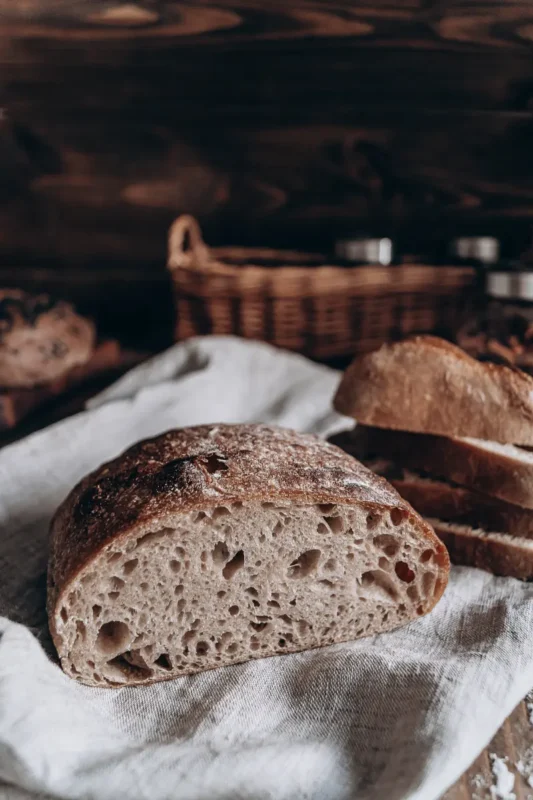
Nowadays, it is more and more difficult to find commercial whole bread that is as healthy as it should be, and most has a glycemic index almost as high as white bread.
This is where the new stars of the show come to the rescue and help you protect your liver better: sourdough and sprouted grain bread.
Authentic sourdough goes through a long fermentation process, which lowers the glycemic index and acts as a prebiotic, which supports your gut health.
Sprouted grain bread, like Ezekiel bread (affiliate link), is another great option. Because the grains are sprouted before milling, the bread is much easier on the liver and contains more available nutrients.
These are the breads I reach for nowadays when I want a sandwich without the liver-damaging guilt, although I have to admit that making my own whole wheat bread at home is still something I do.
Here’s How Much Bread You Should Eat

Unless you are allergic to it, suffer from gluten intolerance or anything else that cuts bread off the menu, you can still eat a bit of bread, as long as you choose it carefully and have it in moderation.
First of all, reduce the portion size. Learn to eat without bread. Try to eat no more than 1 slice per meal and try to introduce as many meals as possible without any bread or similar products (crackers, cereal and so on).
It might sound bad for some, but it’s definitely better than stopping completely. And you get used to it.
Second of all, stop eating white bread! This is the worst type of bread you can have. Switch to eating whole wheat bread instead, or go for the even better ketobreads that I recommended already.
Just make sure that your replacement doesn’t have sugar (in any form like fructose syrup, molasses, or whatnot), additives, preservatives, and such (many gluten-free breads, for example, have them – and they are also high in carbs, like white bread).
Normally, bread should only have three-four ingredients: flour, water, yeast and a bit of salt although the latter is not a must. Various types of seeds or whole flour are OK too.
So never forget the golden rule of thumb: always read the ingredients list! You will be surprised to see how unhealthy store-brought bread generally is!
In most places, it’s very difficult to find bread with just the three recommended ingredients and no preservatives or additives.
This is why it might be a good idea to start making your own bread at home. It’s very easy and I guarantee that you will absolutely love the taste – no store bread can compete with the real taste of fresh bread made at home.
You can buy a bread machine if you don’t have time to do the mixing and baking yourself (it saves you A TON of time). Just add the ingredients there and the machine does the rest of the job.
This is actually the approach that we have taken and the entire family is happy.
We bought this bread machine (affiliate link) and we’re extremely satisfied. It’s an investment you should make too if you want to make sure that you eat the healthiest bread possible.
Conclusion
In my personal experience, reversing fatty liver is about balance and smart choices. You can enjoy bread occasionally if you approach it mindfully, choosing quality over quantity and an overall healthy diet.
Yes, if it is doable, you should stop eating bread completely if you can only buy the low-quality ones from stores. But most people find it very difficult to quit and that’s OK too.
As I said, I haven’t stopped having bread and I still managed to reverse my fatty liver. If you cut bread off your diet and eat fries with bacon and round it up with a cake afterward, you’re not winning your battle!
And as always, this advice is based on my personal experience and research, but you should always consult your doctor for medical advice tailored to your situation.


I was diagnosed with fatty liver in 2014 and successfully reversed it by mid-2015 using a natural diet and lifestyle changes. Since then, I’ve dedicated over a decade to researching this condition and helping others navigate their own recovery. I am the author of ‘From Fatty Liver to Healthy Liver’ and the founder of this community. My goal is to translate complex medical studies into practical, real-world advice that actually works, combined with my personal experience on the matter.
I normally just two slices of Brown Whole Grain Bread now. During the first two months i stopped eating it.
I am still slowly recovering 🙂
I think this is the best approach – completely stop eating for at least a couple of months, then slowly add it back in small portions. Keep it up!
Thank you for this article. I’m from Asia and the only kind of flour I take now is chapathi made out of atta flour. Is this ok to take? I have fatty liver stage 1.
After searching on Google, I found out that this is still wheat flour (whole wheat, fortunately), so what is written in this article should stand for it as well.
My hepatologist told me to stay away from all types of flours, including whole wheat, since they are still all high glycemic and high carb, which turned your liver into fat to begin with. All types of carbs will turn into sugar in the liver, however, more slowly, but it still happens. If you’re not allergic to nuts, use almond flour instead, or if you want to try a little healthier try to bake with quinoa flour. I haven’t tried quinoa flour for bread yet, and I am allergic to nuts & coconut, so that will leave either of those flours out.
Keep in mind, even quinoa flour has 22 grams of carbs in only 1/4 of a cup! Check those labels! Remember, just because it sounds like a healthy flour, doesn’t mean it is. You need to check the glycemic index.
Your article is based on Fatty Liver, what about Cirrhosis, would it be the same recommendation ?
I think that cirrhosis is a much more serious problem and a stricter diet should be followed. I don’t think bread can still be had – but for this, it would be best to talk to a doctor.
Thanks for this info! How do you cut your homemade bread to make sure you’re not having too much? And so you can then put it away to not have it out on the counter calling your name?
Well, this is something you’ll get used to eventually. Cut just the amount of slices (1-2) that you are going to eat, don’t slice the entire bread. Then hide it :))
I love making sourdough bread. The taste and the texture are very satisfying. Is sourdough bread a no-no?
As long as you make it using whole wheats and consume it in moderation, it’s not a no-no.