
Are you finding it hard to stay motivated while trying to lose weight with fatty liver? You’re not alone – I’ve been there on numerous occasions, and many other people face the same challenge.
But with the right strategies, you can overcome it – and I am here to help you learn how to stay motivated long-term.
While this is normal – everybody will hit a wall sooner or later – we still have to stick to our goals, and once we reach them, stay there at our ideal weight (which is probably even more difficult).
So today we’re going to talk about this: how to stay motivated to lose weight for fatty liver, but also how to keep your ideal weight months or years after getting there.
Everybody hits the wall
Usually, everybody is extremely motivated early on – the first few weeks, maybe a couple of months – but eventually most of us start getting back to the old eating habits.
Dieting fatigue sets in, we’re probably starting to feel better, and we just crash or, even worse, consider we did enough.
Unlike losing weight, gaining weight is something that happens a lot faster. You might undo a few weeks of dieting and healthy eating in just a couple of days (I know, I’ve been there!) If you continue, you will be back to your original, unhealthy weight sooner rather than later.
Once you start eating badly again, once you don’t pay as much attention to eating healthy, everything will probably spiral out of control, and it’s a lot more difficult to get back to your ideal weight for the second time.
So staying motivated is essential – and easier done if you follow my advice.
I need your help to keep this website alive! Consider becoming a Patron to help me achieve that. Thank you!
The Daily Habit That Keeps the Weight Off
There are plenty of things one can do to stay motivated, but I have a simple trick that I use and which I am sure will help you too.
After all, reversing your MASLD after losing weight and changing your eating habits and your way of living doesn’t mean much if immediately afterward you restart the past, chaotic lifestyle and gain weight again, making poor choices regarding the food you consume.
Most people doing so will get their fatty liver back and cause more damage to their livers. So it’s vital to keep your weight under control for the rest of your life!
Otherwise, your fatty liver can come back, and, as I said already, you might find it more difficult to start it all over again.
And here is one easy trick that I use, one trick that is deceptively simple, yet extremely useful.
It’s the one thing that helped me keep my weight under control, kept me motivated, and kept me going on with my diet and keeping my weight at or close to the ideal number:
Get a scale, measure your weight daily, and keep a diary of your weight!
This thing is more powerful than you can imagine! And it is vital to measure your weight daily, not weekly, not now and then, and not every couple of days.
Every day, every night, after splurging on a Saturday when you simply can’t say no to that cake, as well as after saying no to a deliciously-looking cake three days after.
A Quick Note on Mental Health
While daily weigh-ins work wonders for my accountability, this might not be the best approach for everyone.
Some people might feel severe anxiety or even get unhealthy thoughts about food – if that is your case, switch to a weekly weigh-in.
Mental health is just as important as physical health, and a weekly check-in will still give you the baseline data you need to spot trends without the daily stress. After all, stress is really bad for MASLD.
But if you can handle the daily feedback, record your data. I do it after splurging on a Saturday when I simply can’t say no to that cake, as well as after making the healthy choice three days later. Keep recording that weight to stay accountable.

Now I know that if I eat pasta or pizza – and yes, I allow myself to have those every now and then, since I reversed my fatty liver, and this is an amazing program to follow for that, the scale will have some bad news for me two days later.
Now use the data you have to set achievable goals, such as losing 2 pounds in the next week, which will keep you motivated and focused. If you set your goal to “lose 25 pounds,” it doesn’t have a limit date, and it’s also discouraging. Set one main goal and divide it into smaller ones!
How to Make the Most of Your Scale
Your scale becomes your best weapon when fighting fatty liver because it has no mercy. It shows you the exact results of your decisions without sugarcoating anything.
Even better, if you have just been diagnosed with a fatty liver, get a scale ASAP (recommendations below) as it will motivate you even more!
I used this method about a week after being diagnosed, after my doctor recommended it to me, and it was awesome.
Early on, if you are significantly overweight, you will see the numbers drop quickly when you change your diet. Watching those digits go down feels incredible and makes you feel awesome.
Depending on your starting point, this rapid loss usually lasts a couple of months before your metabolism naturally slows down.
But you also see the effects of stepping off the path. You learn what a chocolate bar or a heavy takeout meal does to your progress.
You see the difference between eating a leafy green salad for dinner versus a heavy steak.
There will be days when the scale doesn’t show the progress you were hoping for for the long term. When this happens, remember:
- Focus on Non-Scale Victories: Celebrate other successes like fitting into old clothes, having more energy, or sleeping better. One bad meal is not the end of the world and not a reason to completely ditch your diet.
- Stay Positive: Weight loss is a journey with ups and downs and EVERYBODY hits the wall eventually. Don’t let a single bad day define your progress. Keep going, knowing that each healthy choice brings you closer to your goal.
The Vacation Reality Check

I don’t know all the psychological reasons behind why tracking works so well, but I am living proof that it does.
I started at 210 pounds (95.5kg) and lost weight extremely fast during those first couple of months.
I was proud of myself and I loved looking at the paper I kept writing my weight on (because, yes, I’m that old school and keep track of my weight on a piece of paper). I eventually got to my ideal weight, which is 165 pounds. Then I left on vacation.
I didn’t take a scale with me, and I promised to reward myself with everything I wanted, as long as I went for the healthiest options available. It was my first vacation after reversing my fatty liver. I was in great shape, everything was good. Nothing could go wrong.
Except it did! I was shocked to see, when I got home after 10 blissful days, that I had gained 11 pounds. I was still looking good and still, my overall weight was not bad at all… but putting on 11 pounds in 10 days was no joke either!
Sure, a massive portion of that post-vacation weight was actually water retention and glycogen stored in my muscles from the sudden increase in carbohydrates and salty restaurant foods.
This meant the situation wasn’t as catastrophic as that 11-pound number suggested, but it was still a loud warning. Some of that weight was real fat gain, and the trend was heading in a dangerous direction – which is even more dangerous, because getting back to old, bad habits, is always a risk.
And there was another problem: I had no idea I had gained so much weight! If there wasn’t the scale to tell me, I would’ve been happy with the outcome, and maybe during the next vacation, I would’ve eaten the same and added 10 pounds more.
Then I would’ve said yes to an extra cake and eaten more burgers and pizzas because I could’ve said that I wouldn’t gain that much weight. Eventually, I would have drifted right back to my sick and miserable old self.
But when I got home, I had my scale there, telling me that I did some bad things. There was the data before the vacation telling me how bad it was.
And so I started to lose weight again – much slower than I did before, but I eventually got back to my ideal weight.
Get Yourself a Smart Scale!

Initially, I was using a pen and a piece of paper to measure my body’s weight, but there are more modern approaches to this (even though the old-school method works well too!)
I switched to using a smart scale because it has some additional benefits. Apart from measuring your weight, it gives you other nice information, like calculating your BMI, the percentage of body fat, how much water is in your body, and so on.
The biggest benefit, though, is the seamless integration. Smart scales sync directly via Bluetooth or Wi-Fi to Apple Health, Google Fit, or various other dedicated tracking apps on your phone.
Your data is automatically stored, charted, and analyzed. It takes the friction out of tracking – no missing papers, no forgetting to write things down. And as I’ve learned the hard way, friction is the enemy of consistency.
Here are my top recommendations and trust me when I say this: it will change your way of living and help keep you motivated (as long as you use it daily). Affiliate links below:
But honestly, it doesn’t have to be a high-tech gadget. Any standard scale will do the job as long as you use it consistently and record the numbers. The smart ones just offer those data bonuses and digital convenience -and they’re surprisingly affordable as you can see if you look at any of the models above.
I still have the paper I first wrote my initial weight on, back in 2014: 210 pounds (all in kilograms, though), and I love looking at it, then comparing it to my current numbers, which are always around the 165 mark.
You can check this bit of history below and see another reason why smart scales are better – digitally recorded data doesn’t get stains on it.
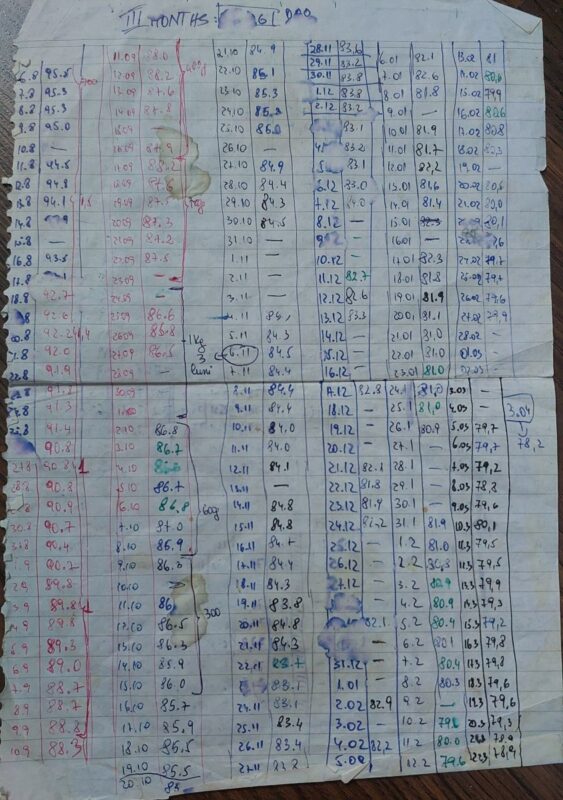
I couldn’t have done it without this simple trick and I am happy to be able to share it with you.
Other Strategies That Keep Me Going
While the scale remains my number one friend, other strategies work well and you can (and should) combine as many as possible with the weighing yourself habit:
1. Know your “why” – and make it specific!
“I want to be healthy” is probably too vague to get you through a Friday night when everyone around you is ordering pizza.
My “why” is very specific: I remember how I felt when I was diagnosed with fatty liver. The fear, the uncertainty, the regret, the huge worry that I wouldn’t get to see my son grow. I never want to feel that way again.
When temptation hits, I go back to that moment in my head, and this gives me the power to keep going. Find your version of that – the specific, personal reason that cuts through the noise when willpower is fading.
2. Build habits, not willpower
I can tell you from experience that willpower ends when you are super hungry and there’s food around you. But you can still say no, even under these circumstances!
Your best ally here is building routines, long term ones that make the healthy choice the default one.
I personally keep any type of junk food (or anything I am not allowed to eat) out of my house. My wife and son have a “hidden” stash I never even look at.
Other things that work are meal prepping (for example, on Sundays, for as much of the week as possible), and having healthy snacks within reach.
These are smaller things that don’t truly require a ton of discipline. They’re just systems that reduce the number of decisions I have to make each day. And the fewer decisions you need to make, the less willpower you burn through – making it easier for you to say “No” when you should.
3. Find an accountability partner
While not always easy or doable, it can help a lot. Your accountability partner can be a friend, a family member, or someone from an online community dedicated to reversing fatty liver disease.
Simply having somebody ask how the diet is going makes you think twice before reaching for something you shouldn’t. Set up meetings once per week to discuss progress and challenges, and it will be easier overall.
4. Track more than just weight!
While weight is indeed, in most cases, the main indicator of our success or failure, other things matter – things that you will notice a short while after making the required lifestyle changes.
I am talking about other things you can and should track if you have the time: your waist measurement, your energy levels, your sleep quality, your mood…
When the scale disappoints you because you’ve hit a plateau, these other markers can keep you motivated. And remember – if you’re getting enough exercise each week, your liver is benefiting even when the scale doesn’t show it.
Wrapping up
So put these all to good use and reverse that fatty liver faster, staying motivated to lose weight and then sticking to that weight! You’ve got this – keep pushing toward a healthier, happier you!

I was diagnosed with fatty liver in 2014 and successfully reversed it by mid-2015 using a natural diet and lifestyle changes. Since then, I’ve dedicated over a decade to researching this condition and helping others navigate their own recovery. I am the author of ‘From Fatty Liver to Healthy Liver’ and the founder of this community. My goal is to translate complex medical studies into practical, real-world advice that actually works, combined with my personal experience on the matter.