
Note: This article is based on my personal experience and research. I am not a doctor or a dietitian, and this content is for informational purposes only. Always consult with your healthcare provider before making any changes to your diet or lifestyle.
After being diagnosed with a fatty liver, you might be tempted to believe that you should reduce the amount of fat you eat to reverse your condition. While this is a good starting point, it’s just one of the things you should do.
Another important one is cutting back on added sugar consumption – ideally, eliminating it completely from your diet, as sugar can be just as damaging, sometimes even more than fat itself.
Here’s what you should know:
Ideally, you should not consume any added sugar if you have fatty liver disease. Sugar equals empty calories that cause harm to your liver, so you should try to avoid it completely.
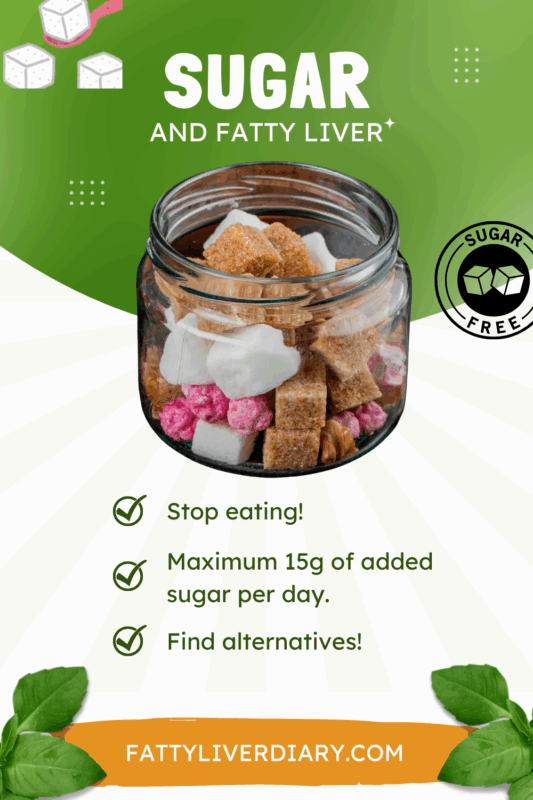
If that is not possible, aim to reduce it as much as possible. In grams, that would be 18 grams for men and 12 grams for women, based on the American Heart Association recommendations for healthy individuals (36 grams for men and 25 grams for women).
NOTE: This article does NOT refer to fatty liver and added sugar for those who also suffer from diabetes. In that particular case, the numbers could be completely different. Discuss this matter with your health provider instead.
So apart from completely eliminating alcohol from your diet, and keeping an eye on the types fats you consume, you also have to be very careful with the amount of added sugars you eat each day.
Why Sugar Matters as Much as Fat
Your body converts excess sugar and refined carbs into fat, which is stored in your liver, which is exactly the problem you’re dealing with when diagnosed with NAFLD/MASLD.
On top of that, added sugars spike your blood sugar, trigger insulin resistance, and cause inflammation. Over time, this worsens the condition and makes recovery harder.
You can read the article “The sweet danger of sugar” over at Harvard University for more details on why sugar is so bad for one’s health, even without the fatty liver diagnosis.
What Counts as “Added Sugar”?
Food companies sneak sugar into products under all sorts of names, not just “sugar”. Check out the ingredient lists for any of the names added sugar can have in processed producs:
- sucrose
- glucose
- fructose
- corn syrup
- malt syrup
- high-fructose corn syrup
- dextrose
- coconut sugar
- maple syrup
- honey
Since we are talking about added sugar, we should also stay away from some of the safer alternatives, like the final three listed above.
A rule of thumb: most ingredients ending in “-ose” are sugars. But not all are “added.” For example, lactose is naturally present in milk. Fructose is naturally foudn in fruit, but it’s also used as an additive in sodas and snacks.
So if you want to make sure that you only eat the things you should do, you should either prepare everything at home from base ingredients (which is difficult today), or read the labels carefully.
You’ll be surprised to see that sugar is added to products you’d never expect: deli meats and sausages (you should stay away from these anyway), bread, sauces, yogurt, etc.
Common Foods and Their Sugar Content
Companies are adding more sugar than they should to most foods (and even to some foods that don’t even need it). In most cases, cutting that amount to half would still deliver a tasty product.
But, to help keep things in perspective, here are some numbers you should consider:
| Food/Drink | Sugar (grams) |
|---|---|
| 12 oz can of Coke | 35 g |
| Snickers bar | 25 g |
| Flavored yogurt (1 cup) | 18 g |
| Blonde Vanilla Latte (Grande) | 35 g |
| Banana (medium, natural sugar) | 14 g |
That can of Coke or a Vanilla Latte (or anything similar) already puts you well over the safe limit for someone with fatty liver. Even the Snickers bar – which many people see as “just a small snack” – is more sugar than you should have in an entire day.
These are just a few examples – most store-bought foods and drinks have more added sugar than they should have.
Remember: we’re talking about added sugars, not the natural sugars found in fruits, vegetables, or whole grains. Those come with fiber, vitamins, and minerals that slow down absorption and actually help the liver.
A teaspoon of sugar stirred into coffee is not the same thing as the natural sugar in a banana (hence its presence in the chart above).
My Experience Cutting Sugar
When I was first diagnosed, I had a real sweet tooth. I always started my day with a coffee with two spoons of sugar and some creamer on top. Cutting that out felt impossible, but I did it. (By the way, here are some liver-friendly coffee creamer alternatives).
What worked for me was reducing slowly. Two spoons became one, then half, then eventually black coffee. Do this over the course of a month – don’t let it drag for too long, though.
These gradual changes will make the transition smoother. Just make sure you keep moving toward the goal, which is no added sugar at all (eventually).
I’ll be honest now: completely eliminating added sugar is very tough. But the closer you get to zero, the better your liver will be, and the healthier you will get.
I do agree that we need carbs from natural sources (our body needs them), but even those consumed in excess will have the same bad effects that plain sugar does. I personally ate fruits in moderation, and I was still able to reverse my condition.
Added sugar is not required in our diet, and our body simply does not need it: it serves no purpose whatsoever. It does make foods and drinks taste better, but otherwise, it’s just empty calories, because we get the required carbs from other food sources anyway (fruits, vegetables, and whole grains).
And there are solid options even when it comes to sweet snacks: check out my recommended liver-friendly dessert ideas here, or learn more about eating chocolate (and how it might help fatty liver).
(You can read one of the many articles on the topic of the uselessness of sugar on the NIH website here.)
And then we’ll have the sugar cravings that we’ll have to deal with. They are a real beast for most (myself included). But it is something that must be done if you want to get rid of your NAFLD.
Do fruits count as added sugar?
It’s actually recommended to have a diet rich in fruits and vegetables: despite the fact that they have a fair amount of sugars, they also have fibers, vitamins and minerals that help our body and liver, and are considered natural sugars that are absorbed slower, and therefore do less harm if any.
Not to mention the fact that our bodies have been consuming fruits for hundreds of thousands of years… so no, don’t even think about eliminating fresh fruit to reduce your sugar intake, as long as you don’t go overboard.
Dried fruits? Kiss them goodbye because they usually have added sugars (and some preservatives too).
Sure, you will need to eat fruit in moderation as well – two pounds of bananas each day, on top of a few pineapples and watermelons are definitely too much. But eating fruits as snacks and toppings without going overboard is definitely healthy and useful.
Remember: our body needs these sugars (carbs) for energy. It just doesn’t need added sugars or excess carbs.
Step-by-Step Sugar Reduction Plan Idea
While there are multiple approaches that will work, if you need some extra guidance, here’s how you can approach this:
- Day 1-2: Stop drinking sodas and fruit juices. Replace with water (or lemon water), sparkling water, or unsweetened tea.
- Day 3-4: Cut the sugar in your coffee/tea by half.
- Day 5-6: Swap desserts for fruit or plain yogurt with real cinnamon.
- Day 7: Start reading food labels, set a hard limit of less than 15 g added sugar per day (and try to get as close to 0 as possible).
Consider this as your personal challenge and understand that every small step you make will greatly impact the health of your liver, and your overall health.
It won’t be easy. Giving up on added sugar was my biggest challenge, but it’s doable. If I managed to do it, anybody can!
And if you’re curious to learn about everything I did to reverse my condition, you can check out my book – From Fatty Liver to Healthy Liver (available on Amazon, Google Play Books, Apple Books and more).
Conclusion
Fatty liver patients need to pay as much attention to sugar as they do to fat. While healthy adults may get away with 25–37 grams of added sugar per day, if you’re dealing with NAFLD, the safe zone is around 12–18 grams at most – and ideally zero.
Always opt for fruits when you feel the need to eat something sweet and learn to sweeten your foods with fruits also (use, for example, a banana instead of sugar when baking sweets).
And if you can’t really cut out all sugars overnight, take it slow, but make it your main goal to reduce sugar consumption drastically if you want to heal your liver.

I was diagnosed with fatty liver in 2014 and successfully reversed it by mid-2015 using a natural diet and lifestyle changes. Since then, I’ve dedicated over a decade to researching this condition and helping others navigate their own recovery. I am the author of ‘From Fatty Liver to Healthy Liver’ and the founder of this community. My goal is to translate complex medical studies into practical, real-world advice that actually works, combined with my personal experience on the matter.
Hi, I got diagnosed with NAFLD nine days ago. I went onto the diet: no sugar, low carbs and no saturated fats diet the same day. Can you get headaches from sugar withdrawal? I’m also feeling irritable and tired. Furthermore, I have been dreaming of sugary carbs like doughnuts and caramel corn! Both are junk foods that I didn’t even eat weekly before!
I am trying to hang on to my sanity. I am very glad I found your site.
Thank-you.
The first couple of weeks are really bad, Brenda. Things get better afterwards, so stay strong. Your body does go through some important changes and the things it was addicted to (the sugars) probably make it react the way it does.
Try to find some replacement for your sweet tooth: eat some fruits, maybe more than usual, to get some satisfaction and stay sane. The key is not to burn out and give in – this is a marathon and you have to stick to it long term.
Thank-you!
What about sugarcane juice? I heard that drinking sugarcane juice actually heals and supports the liver?
I have seen that claim too, but it’s really difficult for me to believe that all those carbs are healthy. I never had it and I wouldn’t recommend it to anybody, to be honest.
I tried drinking some sugarcane juice and definitely all that sugar is not good for me. I heard that it has antioxidants that are good for the liver, but I don’t think it’s a good idea either.
Hi Lynn!
Thanks for your website, it has lots of ideas for coping with the diet changes one needs with this stuff…
I am curious though, why you are so dogmatically against a very moderate amount of alcohol, but ready to
compromise on added sugars.
Both are bad, and both are unnecessary for our bodies. Both are just a question of pleasure, as far as I see it.
I personnally always had the intuition that drinking half a liter of coca cola was rather worse than a pint of beer (of course,
between a liter of rhum and a liter of cola, the answer would be different…).
Is there some scientific data out there that convinced you for your different approach on those two items that are
to be avoided for (non alcoholic) fatty liver disease?
Thanks!
Yes, you are 100% correct. If possible, you should reduce added sugars to 0. I personally believe that it’s more difficult to do it than to cut on alcohol. This is why I think that adding some substitutes or using less might be a better choice here.
In my opinion, alcohol is easier to completely eliminate. And yes, all types of soda/juice should be put on the “not allowed” list.
But no, I didn’t read any studies comparing sugar and alcohol’s potential harm – it’s just a personal opinion. But I did compromise with alcohol as well and started drinking zero alcohol beer every now and then. After one year of not touching it, it will taste like the “real thing” 🙂
Because alcohol is POISON to a liver. Period. And how much more clear can it be? STOP added sugars. The people who love drinking always try to find an excuse.
How many carbs are safe for someone with NAFL?
I have never seen a set amount recommended, but the fewer, the better.
Is organic stevia powder al right to use as a sugar substitute with fatty liver disease?
I have been using it for years no with no problems. Do read the ingredients though, as some labeled as Stevia are mostly erythritol (which I’ve also consumed over the years, but there have been some recent studies raising some questions – I wrote about this on the blog too)
Hi Lynn I have been diagnosed with fatty liver and seems like one article says one thing and one another..Is natural pnut butter ok?And i bought these rx bars cuz thought they were ok, but now im thinking not In my coffee i now put soy milk and monk sugar with a splash of oat creamer..Working on stopping the oat creamer.. Also bought almond butter t put on my apples…If thats ok… And got a recipe for chocolate mouse that contains coconut milk,dates,avacados and cacao..Seems so hard right now
Meryl, everybody feels overwhelmed at first, but there are resources out there to help (even though in some cases they will be contradictory). I recommend getting the advice from professionals and people who have reversed their condition to be sure you’re doing the right things.
To answer your questions generally first – everything without added sugar, too much fat and no preservatives/additives is considered OK in moderation. Some things are better than others, but that chocolate mousse is most likely better than a store-brought bar of chocolate with caramel and peanuts and such.
Same goes for peanut & almond butter – as long as they’re 100% nuts, they are OK (many have added sugar and oils and even flavors). RX Bars are also good and I have them as a treat regularly.
It seems to me that you’re on the right track, so keep it up!